An exterior shutter speed can't prove the tea room: reading this 2023-03 Joan
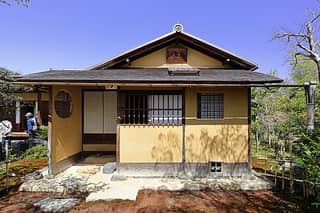
This image is first of all a camera record: March 28, 2023, 11:05, Inuyama, Canon EOS R, 17mm, aperture f/5.6. A wide-angle exterior can only show the persimmon-thatch roof and the garden path. It is famous because on June 9, 1951, the Agency for Cultural Affairs designated the 1618 tea room inside as a National Treasure—and this photograph cannot capture how that room uses skylights for fill light.
The person asking for an image story asks why it is famous. First separate this file from that building, or else one will mistake an exterior shot on a spring morning for an early Edo-period room.
The original file on the shared resource states: the photographer is Tomio344456, the work belongs to the photographer, and the time is precise to 11:05:31 on March 28, 2023. The Exif records a Canon EOS R, focal length 17mm, shutter speed 1/160 second, aperture f/5.6, ISO 100. Pixels 1500 by 1000. The license reads "Attribution-ShareAlike 4.0": reprints must give the photographer's name, and adaptations must carry compatible terms. The Japanese image story places it at Yurakuen in Inuyama, Aichi Prefecture, with the month given as March of Reiwa 5.
Standing on the garden path at 17mm, the lens can vouch only for this: the shingle-capped slope roof is still there, facing trimmed trees and white sand. It cannot vouch for the interior. Japanese Wikipedia, citing the Agency for Cultural Affairs' designation database, gives the National Treasure designation date as June 9, 1951, completion as 1618, and notes it was moved by Meitetsu to its current garden only in 1972. What is famous is the designated tea room, not this spring exterior.
Why the interior repeatedly enters tea-room history is likewise beyond the exterior's help. Japanese Wikipedia describes a lighting scheme: five openings in total on the walls, the south side blocking direct light, the east side reining in brightness with bamboo strips, and the real fill light coming from the skylight near the center of the room that pushes upward. The surroundings are deliberately darkened so that daylight becomes dramatic. Such a judgment must be verified inside the room. The lens on March 28, 2023 faces the roof and cannot see that skylight.
There is another detail in the transfer that an exterior will not tell. When it was moved to the Mitsui main residence in Tokyo in 1908, it was not dismantled: Takejirō, fourth generation of the Hirai family of Kyoto sukiya carpenters, loaded the entire tea room onto a cart as it was and transported it along the Tōkaidō, and later Mitsui's Masuda Takashi loved and used it. So "famous" layers at least three things: the 1951 designation, the unusual lighting scheme of 1618, and the craft that let a small building travel whole. The photograph is responsible only for fixing the location on a spring morning. The builder was Oda Urakusai, younger brother of Oda Nobunaga; of that layer of identity, only the Roman letters "Joan" remain in the filename, and the explanation must return to the documents, not be read from the shutter.
