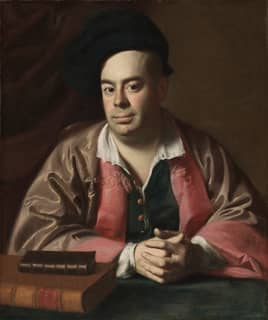
A Silversmith Without His Wig: Copley's Nathaniel Hurd (c. 1765)
Around 1765 John Singleton Copley painted his fellow Boston craftsman Nathaniel Hurd, silversmith and engraver, in a tilted turban and open collar instead of a powdered wig. An unfinished first version survives in Rochester. The finished one is in Cleveland.
Look at the head first. Where a gentleman of 1760s Boston would wear a powdered wig, Nathaniel Hurd wears a soft turban, tilted at an angle over his shaved head. His shirt is open at the collar. He looks straight at us with what the Cleveland Museum of Art calls a "warm gaze and unforced smile." The museum reads that informality, unusual for a portrait of its time, as a sign of friendship between two Boston artists: the painter, John Singleton Copley (1738–1815), and the man in the chair.
Hurd (1730–1777) came from a family of silversmiths. His father Jacob Hurd was a leading Boston maker, and his younger brother Benjamin joined the trade too. Nathaniel became best known as an engraver. He cut crests and monograms on silver, including on pieces made by Paul Revere. He also engraved bookplates for British officers and American patriots alike, designed seals for Harvard and Dartmouth, and engraved designs for Massachusetts paper money. In the finished portrait he wears a silk banyan, the dressing gown of a well-off gentleman. Two books sit by his clasped hands. One is Guillim's Display of Heraldry, the reference he drew his coats of arms from.
There is a second Hurd. The Memorial Art Gallery in Rochester, New York, owns an unfinished Copley portrait of him. In it the face is carefully painted, but the chest and left arm were never completed. He wears the same kind of turban with a plain work shirt, and he gazes off to one side, lost in thought. Nobody knows why Copley stopped. Marjorie Searl, a curator at the Rochester gallery, has suggested that Hurd, or Copley, may have wanted a portrait that showed him more as a gentleman and less as an artisan. As far as she knew, no other pair like it exists.
The Cleveland canvas then took a long trip. According to the museum's provenance record, it belonged to Benjamin Hurd and passed by descent to his son John in Halifax, Nova Scotia. It stayed in Halifax with Hurd descendants into the mid-1800s, was given to Walter Wesselhoeft of Cambridge, Massachusetts, and in 1915 was sold through Boston's Copley Gallery to the Cleveland museum, where it hung in the inaugural exhibition of 1916. Today it is in Gallery 204 (Colonial American), and one more detail from the museum is worth knowing as you look at it: Copley's own in-laws were consignees of the cargo dumped during the Boston Tea Party.
Image credit: John Singleton Copley, Nathaniel Hurd, c. 1765. Oil on canvas, 76.2 x 64.8 cm. The Cleveland Museum of Art, Gift of the John Huntington Art and Polytechnic Trust, 1915.534. Image via Cleveland Museum of Art Open Access, CC0 1.0 (public domain dedication).
- Cleveland Museum of Art object page: date, medium, size, credit line, description, CC0 open access
- CMA Open Access data: CC0 status, provenance, 1916 inaugural exhibition
- Marjorie B. Searl (Memorial Art Gallery), Nathaniel Hurd: Boston Silversmith and Engraver, 1999
- Unfinished Rochester version, MAG 1944.2 (secondary)