Why Jo-an is famous: a tea aesthetic written into light and clay
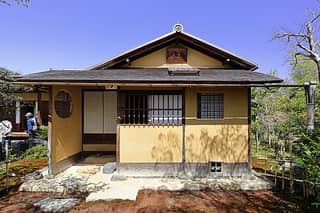
Jo-an turns Oda Uraku’s independent tea aesthetic into architecture: low entrance, exposed wall lattice, bamboo windows, skylight and reused calendars. This photo reveals that design in the walls.
The two dark openings in the pale wall are the best place to begin. They are not ordinary windows fitted onto a finished building. They are shitajimado, “understructure windows”: sections where the outer plaster stops so the bamboo-and-reed skeleton inside the wall remains visible. In this March 2023 photograph, the exposed lattice turns a wall’s hidden construction into its decoration. That small choice helps explain why Jo-an is regarded as a masterpiece rather than merely a picturesque old hut.
Jo-an was created by Oda Uraku, also called Oda Urakusai, a student of Sen no Rikyu and the younger brother of Oda Nobunaga. Japan’s official tourism commentary treats the tea house as Uraku’s supreme achievement and stresses its departure from convention. Uraku did not simply reproduce his teacher’s austere taste. He made a small room that was comparatively spacious, brighter, and attentive to the comfort of guests. Its importance therefore lies in a recognizable personal aesthetic, not only in a famous family connection.
Light is part of that aesthetic. Two eastern openings called urakumado use closely packed vertical bamboo branches. Open, they admit light through the gaps; with paper shoji closed, the branches cast a patterned shadow. A hinged roof panel can also be raised like a skylight. These devices are more than charming details: they show a designer treating changing daylight as an interior material.
The entrance carries a social idea as well. Guests removed their footwear and crawled through the low nijiriguchi; samurai left their long swords on a rack before entering. Inside, the lower walls were papered with old calendars, some dated to 1629. This koyomibari technique reused an ordinary, ephemeral material to evoke the economy of a rustic hermitage. Exposed lattice, filtered sunlight, a humbling entrance, and discarded calendars all belong to the same deliberate visual language.
Jo-an’s National Treasure status and its place among Japan’s three celebrated National Treasure tea rooms confirm its exceptional survival, but the designation alone is not the whole explanation. Its fame comes from the fact that visitors can still encounter Uraku’s choices in physical form. Even an exterior photograph preserves the argument: plaster need not conceal structure, bamboo need not be hidden, and restraint need not mean darkness. The building makes an individual vision of tea culture visible.
