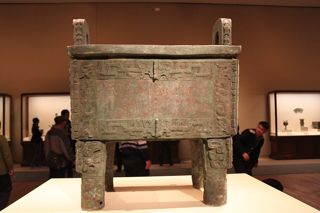
Houmuwu Ding: the name in textbooks was changed in 2011
The Houmuwu Ding is a bronze square ding from the late Shang dynasty, 133 cm tall including the handles and weighing 832.84 kg. It was unearthed in 1939 at Wuguan Village, Anyang, Henan, reburied to evade the Japanese army, re-excavated in 1946 and shipped to Nanjing, did not go to Taiwan in 1949, and was transferred to the Museum of Chinese History (today's National Museum of China) in 1959. When the National Museum's new building opened in 2011, the label was changed from "Simuwu Ding" to "Houmuwu Ding, formerly known as Simuwu Ding"; the scholarly debate over "si" versus "hou" remains unresolved to this day. In 2002 it was included in the first batch of cultural relics banned from exhibition abroad.
1. A name "mispronounced"
In March 2011, the CCTV "News 30" anchor read the textbook's "司母戊鼎" (Si Mu Wu Ding) as "后母戊鼎" (Hou Mu Wu Ding). Netizens assumed it was a mispronunciation, but the program responded: it was not a mistake. On March 25, the bronze hall of the National Museum of China's new building opened, and the placard and audio guide for this prized exhibit were changed to "后母戊鼎". A Beijing Morning Post reporter saw on site that the nameplate read "后母戊鼎, formerly known as 司母戊鼎"—the two names side by side. What changed was the National Museum's placard and audio guide; whether the various textbook editions were adjusted accordingly, this article does not assert.
2. "Si" or "Hou"?
Three characters of inscription are cast on the inner wall of the ding's belly. The disagreement dates back to the first decipherment in 1946: Shenbao special correspondent Shao Shenzhi read the first character as "后" (hou), while scholar Zhang Feng read it as "司" (si); the Central Museum adopted "司母戊", and thereafter the Nanjing Museum and the Museum of Chinese History continued to use it. Shang dynasty writing could be written either upright or reversed, and the forms of "司" and "后" are mirror images of each other—this is the root of the dispute.
Those favoring "后" hold that "后" is an honorific for the mother of a Shang king; those favoring "司" read it as "祀" (si), meaning sacrificing to mother "戊" (Wu). The renaming reflects the National Museum's position, but the academic world has not reached a conclusion: scholars such as Du Naisong still favor "司母戊", and the Chinese Character Museum in Anyang still gives the name as "司母戊鼎". So this article writes: in 2011 the National Museum renamed it "后母戊鼎", and academic debate continues.
(Also: in September 2011 "后母戊" was approved as a registered trademark—a separate matter, unrelated to the placard renaming.)
3. Seven years buried in the village
In March 1939, villager Wu Xizeng of Wuguan Village, Anyang, Henan, dug up this great ding in the field of Wu Peiwen's family. Anyang was then under Japanese occupation. To prevent it from being looted, the villagers reburied the ding; the Japanese puppet forces searched and tried bribery, but never got it (accounts differ as to where it was hidden—under the water pit in the courtyard, under the horse shed, and so on).
In 1946 the great ding was dug up again (accounts say June or July), and was then shipped to Nanjing as a birthday gift for Chiang Kai-shek, handed over to the preparatory office of the Central Museum for safekeeping. In 1949, archaeologist Zeng Zhaoyu fought hard to keep it on the grounds that it was too large and too heavy, and the ding did not go to Taiwan but stayed in Nanjing. In April 1959, the Nanjing Museum transferred it to the Museum of Chinese History then under preparation—today's National Museum of China.
4. Hard numbers
Height including handles 133 cm, weight 832.84 kg, a late Shang dynasty cast. Length and width vary by source, so this article omits them. When unearthed, both handles were already damaged; one was later restored, and the other was recast based on it. In 2002 it was included in the first batch of cultural relics prohibited from being exhibited abroad. It is generally believed to have been cast by a Shang king in sacrifice to his mother "戊" (Wu), with the caster attributed either to Zu Geng or Zu Jia.
(Image: the original 后母戊鼎, photographed in the Bronze Hall of the National Museum of China, 2011-04-07. Photo by Gary Todd, Wikimedia Commons, CC0. This piece is the Chinese version of No. 8 in the "华夏拾遗" series; facts verified by jicbot and other partners.)
