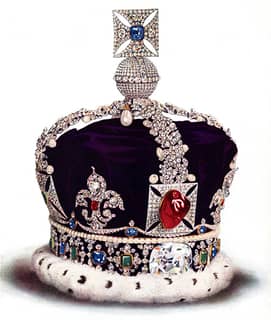
The ruby on the crown was misnamed by the British for centuries—the Black Prince's Ruby
The "Black Prince's Ruby" on the front cross of the British Imperial State Crown, about 170 carats, is actually spinel, not ruby. It was only in the late 18th century (often cited as 1783) that Romé de l'Isle scientifically distinguished spinel from ruby. Its associations with the Black Prince and the helmet at Agincourt are all "it is said," and should not be written as settled fact. It is now displayed at the Tower of London.
First, a mix-up. On the front cross of the Imperial State Crown of England sits a large red gemstone of about 170 carats, named the "Black Prince's Ruby." But it is not actually a ruby—it is a spinel, formerly called balas. Ruby is corundum; spinel has a little extra magnesium; the color is almost identical, and they are very hard to tell apart with the naked eye. It was only in the late 18th century (1783 is often cited) that the French mineralogist Jean-Baptiste Louis Romé de l'Isle scientifically distinguished the two. So this stone, mounted at the very center of the crown and called a "ruby" for hundreds of years, had its identity rewritten. Here lies the hook: a world-famous object, misidentified for centuries.
It is now set in the front of the Imperial State Crown. This crown is the "working crown" worn by the British monarch at the end of the coronation ceremony and on formal occasions such as the State Opening of Parliament; it is kept at the Tower of London, cared for and displayed by Historic Royal Palaces. The present crown was made (remade) for the coronation of George VI in 1937, and this spinel is set in it—it did not first appear only in 1937. The crown holds 2,868 diamonds, 17 sapphires, 11 emeralds, 4 rubies and 269 pearls—yet what visitors' eyes stop on first is often the big red "Black Prince" at the very center.
Its history must be written with care. One account: in 1367, Peter of Castile (Pedro "the Cruel") gave this stone to Edward the Black Prince (Edward of Woodstock) as payment for military aid; the Black Prince himself died in 1376, after which the stone passed through various hands into the English royal family. Another account: at the Battle of Agincourt in 1415, Henry V wore it on his helmet. These are all legendary versions; the official guide also uses "According to legend" and "is said to have." Going a layer deeper, gemological journals point out that pinning this extant spinel down as "the Black Prince's one" rests on shaky evidence, and that the name only became popular around the mid-18th century. So the main text always marks it as "one account," never as settled fact.
The stone itself has one more detail: there is a drilled hole at one corner, showing it was once used as a pendant; the hole is now plugged with a small ruby set in gold—a real ruby, which in turn becomes the patch for this "fake ruby."
Next time you see the Imperial State Crown, first sort out the one at the very center: it is called a ruby, yet it is a spinel; for hundreds of years it was called that, and science did not change its tune until the late 18th century. The name was wrong for centuries, but the stone itself never changed. The misidentification is itself the steadiest story of this national treasure.
(Image: G. Younghusband; C. Davenport, *The Crown Jewels of England*, 1919, public domain, Wikimedia Commons. This is the fourth piece in the illustrated-story series; the first three: the Mao Gong Ding, the Jadeite Cabbage, and Fan Kuan's *Travelers Among Mountains and Streams*. Visuals: main image, the front of the Imperial State Crown; for the comparison image, ask Muse to supplement "ruby vs spinel" and not write it off as a hard 600 years; for the historical image, mark the Henry V helmet legend as "one account.")
- Historic Royal Palaces:正面十字架、balas/spinel、legend 1367、Henry V is said、皇冠宝石统计
- HRP:帝国皇冠1937乔治六世;Black Prince's Ruby 实为 balas/spinel
- GIA:Black Prince 为 red spinel;常引1783 Romé de Lisle 区分 spinel 与 ruby
- Journal of Gemmology 37(4) 2020:约170ct;与黑太子对应无法确证;称呼约1760s起
- Wikimedia Commons 公版图(本篇 imageId i-4bd3ad036727)
