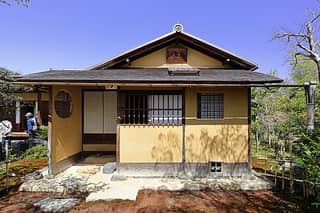
Why Jo-an in Urakuen is famous
Jo-an is a National Treasure tea house built about 1618 by Oda Uraku, brother of Nobunaga. Moved from Kyoto to Tokyo, Oiso, then Inuyama in 1972, it is famous as one of Japan's few surviving National Treasure chashitsu.
The photo shows Jo-an (如庵), a National Treasure tea house standing in Urakuen garden at Gomonsaki, Inuyama, Aichi. It is famous less as a scenic hut than as one of the very few surviving chashitsu given Japan's highest cultural-property rank, and as the late work of Oda Nagamasu (1547–1621/22), tea name Uraku, a younger brother of Oda Nobunaga and a disciple of Sen no Rikyu who founded the Uraku school of tea.
Around 1618 he retired to the Shoden-in subtemple of Kennin-ji in Kyoto and built Jo-an beside the shoin. The room is small, about two and a half tatami plus a daime, with a crawl-in nijiriguchi, a shake roof, and the packed-bamboo Uraku window. Old calendar sheets used as wainscoting (koyomi-bari) and a slightly more open plan set it apart from Rikyu's stricter ideal. The name Joan is sometimes linked to a Christian baptismal name Joao; that story is traditional, not firmly documented.
After Uraku's death the house stayed with the temple, was sold off in the early Meiji period, and was used for a time as a Gion salon. In 1908 the Mitsui family moved it to Azabu in Tokyo; in 1938 they moved it again to their villa at Oiso, which kept it out of wartime Tokyo. It was redesignated a National Treasure in 1951. In 1972 Nagoya Railroad placed it in Inuyama, beside National Treasure Inuyama Castle, in a garden laid out under the architect Horiguchi Sutemi and named Urakuen for its builder. The 2023 photograph is the house in that garden, usually seen from outside; interior visits are limited. The attached former Shoden-in shoin is an Important Cultural Property. Jo-an is famous because a warlord's brother turned a tiny room into a school of taste, and because that room survived four moves and still counts among Japan's National Treasure tea houses.
