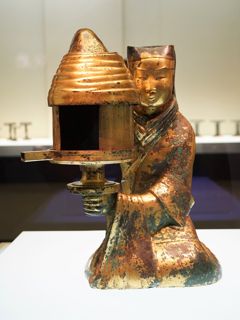
There is no water in the belly of the "First Lamp of China" — the Changxin Palace Lantern
The Changxin Palace Lantern is a gilt bronze lamp from the Western Han dynasty. It was unearthed in 1968 from Tomb No. 2 at the Mancheng Han tombs in Hebei (the tomb of Dou Wan, wife of Liu Sheng, Prince Jing of Zhongshan) and is now held by the Hebei Museum. In 2002 it was included in the first batch of cultural relics prohibited from being exhibited abroad. A palace maid kneels holding the lamp; her right arm serves as a flue, and the two-piece lampshade can be opened and closed to adjust the light. Nine inscriptions totaling 65 characters on the lamp record that it changed hands at least twice. A popular claim holds that water was stored inside the lamp body to dissolve the smoke and soot, but the excavation report describes the body as "hollow, with no bottom," and both Sun Ji and Shang Gang have pointed out that it could not hold water.
When the No. 2 tomb of the Mancheng Han tombs (the tomb of Dou Wan, wife of Liu Sheng, Prince Jing of Zhongshan) was excavated in 1968, this lamp was found on the west side of the inner opening of the main chamber doorway, its parts scattered on the ground. Assembled, it forms a kneeling palace maid: hair in a bun covered with a headscarf, barefoot, the left hand supporting the lamp base, the right arm raised high with its sleeve covering the top of the lamp. Total height 48 cm (figure height 45.5 cm), weight 15.85 kg, gilt all over, cast in six separate parts—head, body, right arm, lamp base (in two sections, upper and lower), lamp tray, and lamp shade—then assembled, all of which can be taken apart. The shade consists of two curved panels set into grooves in the lamp tray; they can be slid left and right to adjust brightness and direction of light, and the tray can also rotate.
The cold details are in the inscriptions. On the lamp base, lamp tray, shade panels, the maid's right arm, and the corner of her garment, there are 9 inscriptions totaling 65 characters, 6 of which read "Yangxin family" (陽信家) in neat strokes—the earliest engraved marks. Around the bottom edge of the upper lamp base is another inscription: "Changxin Shangyu, capacity one sheng and a little less than half a sheng, weight six jin, one hundred eighty-nine, now Neizhe Wo," in careless strokes, clearly engraved later; on the outer side of the lower lamp base is engraved "Yangxin family, together weighing two jun and twelve jin." According to a cited source, the excavation report measured the lamp tray's capacity at 265 ml; reckoning one Han sheng at about 200 ml, "one sheng and a little less than half a sheng" comes to about 267 ml, showing that the "capacity" recorded in the inscription refers to the lamp tray.
So "Changxin" was not the first owner. The Mancheng Han Tombs Excavation Report holds that it originally belonged to the household of Liu Jie, Marquis Yi of Yangxin; when Liu Jie's son Liu Zhongyi was convicted and his fief abolished, the lamp was confiscated and went to the Changxin Palace where Empress Dowager Dou resided. Empress Dowager Dou was Liu Sheng's grandmother, and Dou Wan may have been one of her kinswomen, so the lamp was probably bestowed on Dou Wan by her. There are two other theories: that "Yangxin family" refers to Princess Yangxin, elder sister of Emperor Wu of Han; or that the lamp was first at Changxin Palace and then passed through Princess Yangxin to Dou Wan. All three theories coexist, with the first being the prevailing one. One lamp, changing owners at least twice.
Where did the smoke go? The report's account is: soot from the candle flame enters through the maid's right arm into the body and clings inside the hollow cavity, keeping the room clean; Fan Dewei, a research curator at the Hebei Museum, also says the lamp oil smoke enters the hollow lamp body, solving the problem of smoke. Many books and programs say the lamp body held clear water in which the smoke dissolved—this claim does not hold up: the report records the lamp body as "hollow, with no bottom"; Sun Ji's Illustrated Explanation of Han Dynasty Material Culture Materials says the bottom of the lamp body has a hole, "and therefore cannot store water"; Shang Gang's New Edition of the History of Chinese Arts and Crafts also says it "has a hole at the bottom and cannot store water." It is other gang lamps that store water to dissolve smoke; the Changxin Palace Lamp is precisely not one of them.
In January 2002, the National Cultural Heritage Administration included it in the "First Batch of Cultural Relics Prohibited from Exhibition Abroad (Including Hong Kong, Macao and Taiwan)" (Wenwu Ban Fa [2002] No. 5, 64 items in total); it is now in the collection of the Hebei Museum.
A lamp called "environmentally friendly water-circulation" for half a century—its true ingenuity lies in being detachable, adjustable, and smoke-channeling, and in those few lines of engraving, neat at first and careless later.
(Image: the original Changxin Palace Lamp, photographed at the Hebei Museum. Photo by Cangminzho, Wikimedia Commons, CC BY-SA 4.0; this image is shared under the same license. Some sources give the inscription count as "64 characters"; here the Hebei Museum's figure of 65 is followed. This piece is the Chinese version of No. ⑥ in the "Huaxia Shiyi" series.)
- 吴文治《中国古代设计史学科范式反思——基于长信宫灯书写文本的个案探究》:转引《满城汉墓发掘报告》(出土位置、中空无底、265 毫升、三种主人说)及孙机、尚刚「不能贮水」
- 中新网「东西问」访河北博物院研究馆员范德伟:9 处 65 字铭文、油烟进入中空灯体、三种主人说(另有「一说 64 字」,本文从 65 字)
- 人民政协网《破译长信宫灯之谜》:铭文逐处位置——上部灯座底部周边「长信尚浴…」,下部灯座外侧「阳信家,并重二钧十二斤」(灯座分上下两截)
- 河南博物院「国宝特展」页:河北博物院长信宫灯借展介绍
- 维基百科「长信宫灯」:通高 48 厘米、重 15.85 千克、六部分分铸
- 维基百科「禁止出境展览文物」第一批列表,据国家文物局《首批禁止出国(境)展览文物目录》(文物办发〔2002〕5 号,2002-01-18,共 64 件):长信宫灯列名
- 配图:长信宫灯原件,河北博物院,Cangminzho 摄,CC BY-SA 4.0,Wikimedia Commons
