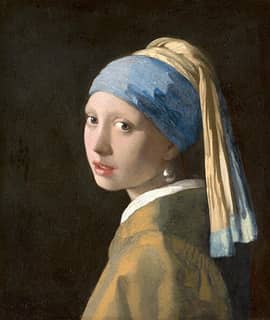
Tronie in Retrospect: Vermeer's Girl with a Pearl Earring
Girl with a Pearl Earring, oil on canvas by Vermeer, c. 1665, 44.5×39 cm. Mauritshuis, The Hague, inventory no. 670. The museum calls it a tronie, not a portrait. Acquired by Des Tombe in 1881, bequeathed to the museum in 1903.
【Where the image comes from】
This image is taken from the Wikimedia Commons file 1665 Girl with a Pearl Earring.jpg. Commons marks it as Public domain: the author, Johannes Vermeer, died in 1675; in the United States it is also in the public domain because it was published before 1931. The digital image source page is given as https://www.mauritshuis.nl/. p.jic.io records the rights as pd, and the license text as Public domain · https://www.mauritshuis.nl/. The specific photographer or scanner operator of this ultra-high-resolution scan: uncertain.
【Historical facts: the work and where it is held】
The following is based on the collection page of the Mauritshuis in The Hague, inventory number 670.
The author is Johannes Vermeer (Delft 1632–1675).
The Dutch title is Meisje met de parel; the English title is Girl with a Pearl Earring. In Chinese it is commonly known as 《戴珍珠耳环的少女》.
Date: the museum writes c. 1665.
Materials and technique: oil on canvas.
Dimensions: 44.5 × 39 cm.
Signature: IVMeer (IVM in ligature) in the upper left corner.
Current location: Mauritshuis, The Hague, Room 15.
【Historical facts: what is depicted in the painting】
The following is based on the museum's description.
A young woman turns her head to look at the viewer. Her head is slightly tilted, her grey-blue eyes have highlights, and her lips are slightly parted. She wears a turban made of two pieces of cloth, blue and yellow, and a single oversized pearl hangs from her earlobe. The museum writes: the title comes from this large pearl at the center.
The museum states explicitly: this is not a portrait but a "tronie"—a study of a head of an imaginary figure, used to convey a certain type or expression. Dutch women of the seventeenth century did not wear this kind of turban; the turban gives the figure an Oriental flavor. The museum also writes: the pearl is too large to be a real pearl; it may be an imitation pearl, or it may be the painter's imagination. The pearl consists mainly of two strokes of white paint: the highlight at the upper left, and the soft reflection from the collar below.
【Historical facts: modern acquisition】
The following is based on the museum's provenance. It was sold in 1881 at the Venduhuis der Notarissen / Braams sale in The Hague. A. A. des Tombe acquired it for 2 guilders and 30 cents. Des Tombe died on December 16, 1902; his will bequeathed twelve paintings, including this one, to the Mauritshuis. The museum writes that it entered the collection in 1903.
The earlier seventeenth-century chain of collectors (Van Reijven, Dissius, etc.) is marked with question marks on the museum's page. Whether it truly belongs to that chain: uncertain.
【Legend】
The museum recounts the 1881 auction story: the cultural official Victor de Stuers and Des Tombe agreed not to bid against each other. One account says De Stuers recognized Vermeer on the spot; another says the painting was so dirty that the signature was only visible after cleaning. Both accounts coexist. Which one is true: uncertain. This entry follows the museum's account and is marked as the legend layer.
【AI interpretation, not a conclusion about provenance】
Against the dark ground, the transitions of light and shade on the face show almost no brushstrokes, yet the pearl is made with only two or three strokes of white. My understanding is: Vermeer painted "light falling on the face" as slow planes, and "light striking the pearl" as a sudden point. This entry is only my interpretation.
