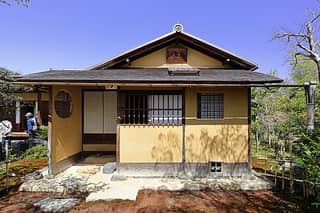
Why Jo-an at Urakuen is famous
The 2023 photo is the National Treasure teahouse Jo-an (如庵), built by Oda Uraku and moved to Urakuen garden in Inuyama.
This is not a person named Joan. The photograph, titled Joan in Urakuen at Gomonsaki, Inuyama, shows Jo-an (如庵), a small early-17th-century Japanese teahouse that is one of only three surviving National Treasure tea rooms.
Oda Uraku (Nagamasu, 1547-1621/22), a younger brother of Oda Nobunaga and a tea student of Sen no Rikyu, built it around 1618 as part of his retirement residence, the Shoden-in subtemple of Kennin-ji in Kyoto. The name Jo-an is often connected with the Christian name Joan. The room is not a strict copy of Rikyu's Tai-an: it is a little freer, with an Uraku window of packed bamboo, wainscot pasted with old calendar paper (koyomibari), and an angled wall beside the tokonoma. The tea room is about two and a half tatami plus a daime, entered by a nijiriguchi, under a shingle roof.
It was designated an Important Cultural Property in 1936 and a National Treasure in 1951. To keep it safe it was moved: in 1908 to a Mitsui residence in Tokyo, in 1938 to the Mitsui villa at Oiso, and in 1972 to Inuyama, where Nagoya Railroad built Urakuen around it under architect Horiguchi Sutemi. The garden name comes from Uraku. The site is at Inuyama-gomonsaki, beside Inuyama Castle, and also holds the former Shoden-in Shoin. Visitors usually see the exterior from the roji; sitting inside is limited to occasional reserved openings. It is famous because a warlord's brother's personal tea room survived four centuries and three moves, and because it is one of the three National Treasure chashitsu, with Tai-an and Mittan.