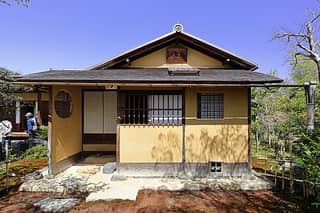
Jo-an: The National Treasure Tea House Left by Oda Urakusai
"Joan" is actually a mislabeling of "Jo-an" (如庵) — one of Japan's three great tea houses and a designated National Treasure, located in Urakuen in Inuyama, Aichi Prefecture. Built around 1618 at Kennin-ji in Kyoto by Oda Urakusai, the younger brother of Oda Nobunaga, it was designated a National Treasure in 1951 and relocated to its current site in 1972. It is a model building of the wabi-sabi spirit of Japanese tea ceremony.
The thatched-roof tea house in the photo is named Jo-an in Japanese, but the image site's title mistakenly wrote it as "Joan." It is one of Japan's most celebrated tea houses, counted alongside two others as one of the "Three Great Tea Houses," and was designated a National Treasure of Japan in 1951.
Jo-an was built around 1618 at Kennin-ji in Kyoto for Oda Urakusai (1547–1621). Urakusai was the younger brother of the Sengoku warlord Oda Nobunaga and a disciple of the tea master Sen no Rikyū; in his later years he withdrew into the way of tea under the name "Uraku." Jo-an was built for his own tea gatherings.
The tea house was later relocated several times, settling in 1972 at Yūrakuen in Inuyama, Aichi Prefecture—the garden takes its name from Urakusai. This was once Owari Province, ruled by the Oda clan from the 15th century, so in a sense it returned home.
Jo-an is revered as a masterpiece because it carries wabi-sabi to its extreme: the tea room is just two and a half tatami mats plus a "daime" (three-quarters of a mat) and a tokonoma alcove, with a three-mat preparation room and a one-and-a-half-mat anteroom; visitors must stoop through the low nijiriguchi entrance, symbolizing that all who enter the tea room are equal regardless of rank. The thatched roof and bamboo lattice windows express restraint and simplicity everywhere.
Today Jo-an stands quietly deep within the roji (garden) of Yūrakuen, a living monument to the spirit of Japanese tea ceremony: harmony, respect, purity, and tranquility.