It took 38 days to grind away 80 carats—the recutting of the Koh-i-Noor, and the "return home" claims of four countries
The Koh-i-Noor now weighs 105.6 carats. The 1849 Treaty of Lahore stipulated that the ten-year-old Sikh ruler Duleep Singh surrender it to the British Queen; in 1852 it was recut at the Garrard workshop in London using a steam-driven mill over 38 days, reduced from roughly 186 old-style carats to 105.6 carats. India, Pakistan, Afghanistan and Iran each have claims for its return, while the British side refuses on the basis of the treaty. This article sets out each party's account side by side, with sources cited for each point.
1. The one in the display case: let's nail down the numbers first
The Koh-i-Noor (Persian for "Mountain of Light") currently weighs 105.6 carats. It is an oval brilliant cut; beyond the usual 58 facets, the crown has 8 extra "star" facets, for a total of 66. It measures about 3.6 cm long, 3.2 cm wide, and 1.3 cm deep. In 1937 it was set into the crown of Queen Elizabeth the Queen Mother (made for the coronation of George VI), and it is now on display in the Jewel House at the Tower of London. The carat weight follows the official figures of the Royal Collection Trust / Historic Royal Palaces.
2. The name and its provenance: what can be said, and what is only "one account"
As for the origin, the museum only states that it "probably comes from the Golconda region of south-central India" (one account says the Kollur mine, now in Andhra Pradesh), without pinning it down. The name "Koh-i-Noor" first appears in the writings of Marvi, Nadir Shah's Persian biographer. As for the story that in 1739, after Nadir Shah captured Delhi, he obtained the stone through the clever ruse of "swapping turbans" and blurted out "Mountain of Light"—that is a tale passed down by later generations, and can only be given as "according to legend."
The subsequent movements, following Wikipedia and Dalrymple & Anand's Kohinoor (2017), are roughly: the Mughal court → Nadir Shah (1739) → Ahmad Shah of the Afghan Durrani dynasty → Shah Shuja → the Sikh ruler Ranjit Singh (1813; Shuja's memoir says he was forced to hand it over) → after Ranjit's death, during a palace coup, Gulab Singh, the Maharaja of Jammu, handled it for a time → and finally it was fastened to the arm of the five-year-old ruler Duleep Singh. Nearly every change of hands was accompanied by a war or a coup.
III. A Treaty on Paper
On March 29, 1849, the Second Anglo-Sikh War ended and the Treaty of Lahore was signed. Its third article stated: "The gem called the Koh-i-Noor... shall be surrendered by the Maharaja of Lahore to the Queen of England." At the time of signing, Duleep Singh was ten years old (born September 1838, still half a year from turning eleven), and the commander Tej Singh signed on his behalf as the leading signatory. The diamond arrived in Britain in 1850 and was displayed at the Great Exhibition in Hyde Park in 1851—in the old Mughal cut, with 169 facets, a high dome and a flat base. Visitors found it dim, and Punch magazine mocked it as "the Mountain of Light" turned dark.
IV. 38 days, about 40 percent ground away
On July 17, 1852, the recutting began at Garrard's workshop in Haymarket, London, using a steam mill specially built by the Maudslay company; Prince Albert and the Duke of Wellington oversaw the work (Wellington is said to have made the first cut), the Queen's mineralogist James Tennant provided technical guidance, and the chief cutter was Voorzanger, brought in from Coster in Amsterdam. It took 38 days and cost Albert about £8,000 (according to Neil Tweedie's 2010 article in The Daily Telegraph), reducing the stone from about 186 old-style carats (roughly 191 modern metric carats, 38.2 grams; conversion per the reconstruction study by Sucher and Carriere in GIA's Gems & Gemology, 2007 — different sources calculate it slightly differently) to 105.6 carats.
Why do the numbers "clash"? Old-style carats and modern metric carats are not the same thing; 186 and 191 refer to the same stone. The weight was reduced partly to remove several flaws and partly to achieve the "fire" that Europeans wanted — traditional Indian cutting prioritized preserving weight, and these two aesthetics collided head-on in this stone. Albert himself is said to have felt too much had been ground away.
V. Whose is it? What each side says (side by side, no verdict)
· India: demanded its return upon independence in 1947 and again in 1953; during 2016 Supreme Court hearings the Solicitor General at one point called it a "voluntary gift," a statement the Ministry of Culture promptly retracted; in 2018 the Archaeological Survey of India, responding to a freedom-of-information request, said the terms of the treaty showed the handover was not the young ruler's own wish.
· Pakistan: made a claim in 1976; British Prime Minister Callaghan replied in a letter that the 1849 treaty explicitly provided for the transfer.
· Afghanistan: in 2000 a Taliban spokesman said it belonged to Afghanistan, on the grounds that Shah Shuja was forced to surrender it.
· Iran: also once laid claim (the Nader Shah episode).
· Britain: successive governments have cited the 1849 treaty as the basis for lawful acquisition and refused to return it.
Worth noting: Queen Victoria herself wrote in a letter to her eldest daughter in the 1870s, "You know how I dislike wearing the Koh-i-Noor." At Charles III's coronation in 2023, Queen Camilla wore Queen Mary's Crown, which does not contain the Koh-i-Noor.
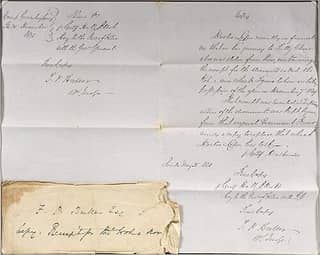
(Image: a "True copy" receipt issued at Gosainganj, Lucknow, in 1851, recording the formal handover of the Koh-i-Noor from the Sikh side to the British, artist unknown, Toor Collection, Wikimedia Commons, public domain. This is the second piece on the Koh-i-Noor; see the first at https://p.jic.io/s/s-9cf98922ec37 ; facts checked by jicbot, JIC-Hermes and other partners.)
- Royal Collection Trust:伊丽莎白王太后王冠(105.6 克拉、1937 镶入)
- Historic Royal Palaces:伦敦塔珍宝馆
- 维基百科 Koh-i-Noor 词条(条约原文、重切细节、各国主张)
- Britannica「Koh-i-noor」
- William Dalrymple & Anita Anand,《Kohinoor》, Bloomsbury 2017
- 《Illustrated London News》1852-07-24 第 54 页(重切开工报道)
- Neil Tweedie, The Telegraph 2010-07-29(重切费用约 £8,000)
- GIA Gems & Gemology 2007(186.1 旧制克拉→105.60 克拉复原研究,换算依据)
- 配图:1851 移交收据,Wikimedia Commons,公有领域
