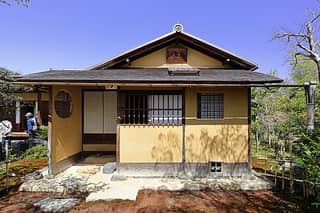
Joan: One of the Three Great National Treasure Tea Rooms, the surviving legacy of Oda Urakusai
Joan is a two-and-a-half-mat tea room with a daime, built around 1618 by Oda Urakusai, the younger brother of Oda Nobunaga. Designated a Japanese National Treasure twice, in 1936 and 1951, it is counted alongside Taian and Mian as one of the three surviving National Treasure tea rooms.
Joan is one of only three National Treasure tea houses remaining in Japan, located within Yūrakuen in Jōnokoshi, Inuyama City, Aichi Prefecture. It was built around 1618 by Oda Urakusai (Oda Nagamasu), a tea master and the younger brother of Oda Nobunaga, originally within Shōden-in, a sub-temple of Kennin-ji in Kyoto, as Urakusai's retirement tea house in his later years.
It is famous on three counts:
1. An illustrious owner — Urakusai was the brother of the Sengoku warlord Oda Nobunaga; after the Siege of Osaka he shaved his head and withdrew into seclusion, and his tea practice descended from Sen no Rikyū. Joan is the crystallization of his tea aesthetic.
2. A rare form — the tea room is only two and a half mats plus a daime, with a three-mat mizuya and a corridor; it has a kirizuma-zukuri (gabled) roof of persimmon-shingle thatch. Because its lower walls are covered with old calendars it is called the "Calendar Seat," and because of the slanted wall beside the alcove post it is called the "Slanted Seat." It has been rated by Japan's Agency for Cultural Affairs as a model of tea rooms of its type.
3. Distinguished status — it was designated a National Treasure twice: on April 20, 1936 under the old law, and on June 9, 1951 under the Cultural Properties Protection Act. Together with Myōkian's "Tai-an" and Daitoku-ji Ryōkō-in's "Mittan," it is one of only three National Treasure tea houses remaining, and the only one that can be viewed up close at any time.
Joan has had a checkered fate yet survives intact: at the end of the Meiji era it passed to the Mitsui family along with its garden and shoin, and was moved to Tokyo; in 1938 it was moved to Kanagawa, and in 1972 it was moved back to its present site. Today it is owned by Meitetsu (Nagoya Railroad). Its exterior can be viewed freely when the garden is open; the interior is opened to the public only once a month for a special viewing (reservation required, about 4,000 yen including matcha).