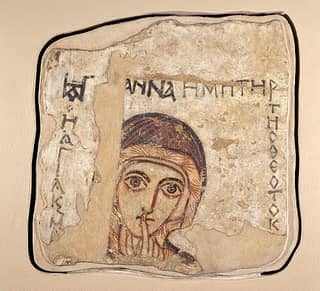
Saint Anne, painted on a church wall in the 8th century
A surviving fragment of an early medieval wall painting showing Saint Anne, the mother of the Virgin Mary, now in the National Museum in Warsaw.
What this is: a fragment of a wall painting — not a framed picture but a piece of plaster cut out of a church interior — showing Saint Anne. The National Museum in Warsaw dates it to the 8th or the first half of the 9th century CE and records the author as unknown, which is normal for monumental painting of that period: murals were workshop products, and the painter's name was never written down.
Who she is: Anne is not named in the canonical gospels. Her story comes from the Protoevangelium of James, a second-century apocryphal text that names Mary's parents as Anne and Joachim and describes their long childlessness, the angelic annunciation of her birth, and their dedication of the child to the temple. That text is why Anne became one of the most frequently painted saints of the Christian Middle Ages: she is the grandmother of Jesus, and by extension the patron of mothers, of pregnant women and of grandmothers.
Why she appears on a wall: medieval churches were painted rather than read. A mural cycle let a congregation that could not read Latin follow the sacred story through images, and Anne belonged to the genealogical cycles that traced the ancestry of Christ. A single surviving fragment like this one is usually the last remainder of a much larger programme — the rest was lost to rebuilding, damp, whitewash or iconoclasm, and what we see today is one figure cut out of a composition that once covered an entire wall.
What survives technically: pigment bound on a plaster ground, the standard medium for church interiors east and west in this period. Fragments are collected precisely because the plaster carries the only record of the original surface; the boundary of the fragment is an accident of conservation, not of the artist's design.
Why it matters: paintings of this date that survive at all are rare, and they are the main evidence for how early medieval workshops composed figures, mixed pigments and organised a wall. A fragment of a single saint is a document of a whole workshop practice.
Note on provenance: the museum record gives the date and holding but does not, in the metadata available here, state the building the painting came from; I have not filled that gap with a guess.
- File record: unknown author, Saint Anne - fragment of a figure, wall painting, 8th - first half of 9th c. CE, public dom
- National Museum in Warsaw collection record cited as the source of the image.
- Anne as mother of Mary and her role in Christian iconography; the Protoevangelium of James as the source of her story.
