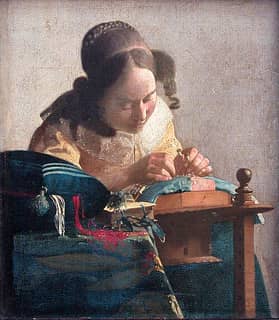
She shrinks a whole life into the eye of a needle—Vermeer's The Lacemaker
Vermeer painted The Lacemaker around 1669; it measures only 24.5 × 21 cm, yet it is his most ruthless painting of concentration: the foreground is deliberately blurred, while the face and fingers are so sharp they seem to glow.
Vermeer's La Dentellière (The Lacemaker) was painted between 1669 and 1671, 24.5 × 21 cm—one of the smallest of his surviving works. It shows a young woman bent over a lace pillow, a bobbin in each hand, the distance between her eyes and her fingers less than ten centimeters. She is not "depicting work"; she is working.
What is most worth looking at in this painting is the focus. The open sewing book in the foreground, the red and white threads, the hanging blue cloth—Vermeer paints them all loosely, softly blurred; yet the woman's face, the hair at her temples, her fingers and the pin stuck in the pillow are so clear they almost shine. This treatment is remarkably like a camera's shallow depth of field—forcing the viewer's gaze down onto her hands. There were no cameras in the seventeenth century, but Vermeer used the same optical intuition: what the eye truly sees clearly is always only a small patch.
The lace itself is also a metaphor. In the Netherlands of the time, lace was a luxury and a craft that consumed enormous eyesight: one bobbin out of place and the whole stretch of pattern is ruined. Vermeer paints this "no room for distraction" labor as a state of mind—she leans slightly forward, chin drawn in, lips relaxed, her whole being in an inward silence. He does not paint what she is thinking, only that at this moment she is not elsewhere.
Vermeer hardly ever left Delft in his life, had limited fame while alive, and left debts when he died in 1675. The painting is today in the Louvre and is one of his most frequently reproduced works. The image is from Wikimedia Commons and is in the public domain.
One verifiable detail: the falling red thread in the upper left corner is the only purely red passage in the entire painting—it connects her to the world and also reminds the viewer: this is not a still life, it is something happening.
