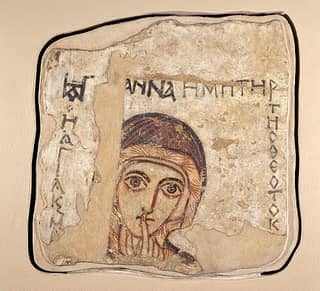
Saint Anne from Faras Cathedral at the National Museum in Warsaw: The Nubian Madonna
This painting, Saint Anne (Święta Anna), is a fragment of an 8th–9th century church mural from Nubia (the Kingdom of Makuria), depicting the head and shoulders of Saint Anne, the mother of the Virgin Mary, along with a hand pressed to her lips. It comes from Faras Cathedral in present-day Sudan, was excavated in the 1960s by a Polish archaeological team during UNESCO's Nubia campaign, and has been held at the National Museum in Warsaw since 1964, where it has long served as the museum's logo.
This is a fragment of a Nubian wall painting dating back about 1,200 years, on the theme of "Saint Anne"—in Christian tradition, the mother of the Virgin Mary and grandmother of Jesus.
The painting comes from Faras Cathedral. Faras was located in ancient Nubia, in what is now Sudan, and was once an important religious center of the Kingdom of Makuria. In 1959, with the Aswan High Dam in Egypt about to impound water, a large number of sites in the Nile Valley faced flooding, and UNESCO launched the "Nubian Campaign," with archaeological teams from many countries carrying out emergency rescue excavations. The Polish team, led by Kazimierz Michałowski, discovered dozens of well-preserved medieval wall paintings on the walls of Faras Cathedral, and "Saint Anne" is one of them.
The image preserves only Saint Anne's head and shoulders, along with one hand lightly pressed to her lips—this gesture of "finger to lips" is usually interpreted as "silence" or "awe in prayer," and some scholars also connect it to keeping silent about the mystery of the newborn child. She wears a purple hooded cloak (maphorion); her face is elongated, her nose straight, her eyes wide open, and most unusually, her head lacks the golden halo commonly seen in icons—something rarely seen in portraits of saints.
When this painting was discovered, it was on the wall of the north nave of the church, about three meters above the ground, painted on the first layer of plaster and later covered by a second layer of plaster depicting Queen Martha—precisely because it was covered, it survived the ages and is preserved to this day.
Since 1964, it has been held in the National Museum in Warsaw, displayed in Room VI of the Faras Gallery, and has become the museum's signature image. A Holy Mother buried in sand by the Nile for a thousand years ultimately became a calling card of Poland's capital—this is precisely the most moving footnote the "Nubian Campaign" has left to later generations.
