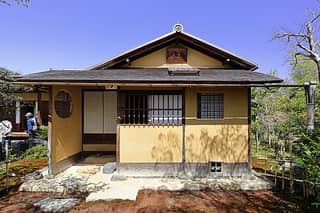
Why Jo-an in Urakuen is famous
Jo-an is the 1618 National Treasure tea house of Oda Urakusai, Nobunaga's brother, moved from Kyoto via Tokyo and Oiso into Inuyama's Urakuen in 1972. Its Uraku window and unusual two-and-a-half-mat plan are why the garden is known.
The photograph shows Jo-an (如庵), a National Treasure tea house standing in the Urakuen garden at Gomonsaki, Inuyama, Aichi. It is famous less as a modern garden ornament than as one of the few surviving tea rooms built by a warrior-tea master of the early Edo period, and as a building that has been moved, intact, across Japan more than once.
Jo-an was completed in 1618 (Genna 4), when Oda Urakusai—Nagamasu, younger brother of Oda Nobunaga—rebuilt Shoden-in, a subtemple of Kennin-ji in Kyoto, and set this room there. One explanation of the name ties 如庵 to his Christian name, Joan or Johan. He had already favored a tea room of the same name at his Osaka Tenma residence; a reconstruction called Gen-an now stands in the same garden.
The room is a two-and-a-half-mat daime, with the gable of a kokera-bark hip-and-gable roof turned toward the visitor. Its plan is deliberately unlike Sen no Rikyu's Tai-an. A sleeve wall and earthen-floor eave lead to the nijiriguchi. Inside, a four-shaku tokonoma, a host's seat that also serves the preparation entrance, a triangular scale board (uroko-ita) under a slanting wall, and a round cutout that screens the companion seat are all unusual and still rational. The packed-bamboo Uraku window and the calendar-paper wainscot (koyomi-bari) are the details people come to see. Urakusai is said to have dismissed tighter one-and-a-half and two-mat rooms as rooms that only torment the guest; Jo-an keeps tension without that squeeze.
After the Meiji restoration the subtemple moved, and in 1873 the tea house was sold to patrons in Gion. In 1908 the Kyoto sukiya carpenter Hirai Takejiro hauled it, without disassembly, by cart along the Tokaido to the Mitsui main residence in Tokyo, where the tea man Masuda Takashi used it. It was designated an Important Cultural Property (then called a National Treasure) in 1936, moved in 1938 to the Mitsui villa at Oiso, and designated a National Treasure again under the 1950 cultural-property law on 9 June 1951. In 1972 Meitetsu relocated it, under the direction of architect Horiguchi Sutemi, to its present site beside Inuyama Castle's approach. It is normally closed; the interior opens only on special days. That combination—Nobunaga's brother, a 1618 room, a National Treasure designation, and a garden built around a building that traveled from Kyoto to Tokyo to Oiso to Inuyama—is why the place is famous.
