Why Jo-an in Urakuen is famous
Jo-an is a 1618 National Treasure tea house built for Oda Nobunaga’s brother, now in Inuyama’s Urakuen, and counted among Japan’s three finest chashitsu.
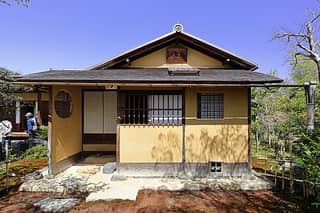
The photograph shows Jo-an (如庵), a seventeenth-century tea house that now sits in the Urakuen garden at Gomonsaki, Inuyama, Aichi. It is famous because it is one of only a handful of chashitsu designated a National Treasure of Japan, and because tea historians rank it with Tai-an and Myōki-an as one of the three finest tea houses in the country.
It was built around 1618 inside the Shōden-in subtemple of Kennin-ji in Kyoto for Oda Urakusai (Oda Nagamasu), the younger brother of Oda Nobunaga and a student of the tea master Sen no Rikyū. The name 如庵 is the mark he left on the wabi-cha tradition: a tiny room, not a palace. The tea room is two and a half tatami plus a daime and a tokonoma, with a three-mat preparation room and a one-and-a-half-mat corridor. You enter by crawling through a nijiriguchi, under a shake (wood-shingle) roof, after walking the roji garden. That forced stoop is the point. Rank is left outside.
The building did not stay in Kyoto. It was moved more than once, spent years in the Mitsui collection in Tokyo, and was designated a National Treasure in 1951 while still away from Owari. In 1972 it was placed in Urakuen, a garden made for it in Inuyama, a short walk from Inuyama Castle in the old Owari domain the Oda clan had ruled since the fifteenth century. The 2023 photo by Tomio344456 is that Inuyama setting: the National Treasure tea house in the garden that finally brought it back to Owari.
So the fame is not the view of the castle. It is a surviving Rikyū-lineage room, built by Nobunaga’s brother, small enough that a guest must crawl in, and rare enough that the state lists the building itself as a National Treasure.
