Why Jo-an in Urakuen is famous
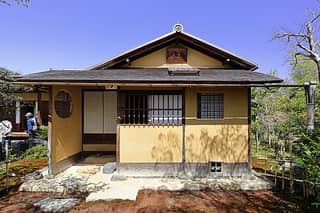
Jo-an is a National Treasure teahouse built about 1618 for Oda Urakusai, Nobunaga’s brother and a student of Sen no Rikyū. Since 1972 it has stood in Urakuen, Inuyama — the room in this 2023 photo.
The photograph shows Jo-an (如庵), a small seventeenth-century Japanese teahouse now standing in the Urakuen garden at Gomonsaki, Inuyama, Aichi. It is famous less for size than for who built it and what the Japanese state later decided it was worth keeping.
Oda Urakusai (also called Oda Nagamasu), younger brother of the warlord Oda Nobunaga and a student of the tea master Sen no Rikyū, had Jo-an built around 1618 at Kennin-ji in Kyoto. After Rikyū's death, Urakusai became one of the people who carried the wabi-cha taste into the next generation: a room small enough that guests crawl in through a nijiriguchi, a shake (wood-shingle) roof, and a tea room of only two and a half tatami plus a daime and a toko alcove. Beside it sit a three-mat preparation room (mizuya) and a one-and-a-half-mat corridor room. The approach is a roji, the "dewy ground" garden that is meant to slow you down before the tea.
The building did not stay in Kyoto. It was moved more than once. Since 1972 it has been part of Urakuen in Inuyama, in the old Owari domain that the Oda family ruled from the fifteenth century. That is the setting of this 28 March 2023 photograph by Tomio344456: the National Treasure in its current garden, not on its original Kyoto site.
In 1951 Jo-an was designated a National Treasure. Guidebooks still group it with Tai-an and another surviving Rikyū-circle room as one of the three finest teahouses in Japan. The fame is architectural and historical at once: a rare early-Edo chashitsu tied to Nobunaga's brother, Rikyū's lineage, and a room that has survived by being carefully taken apart and rebuilt.
