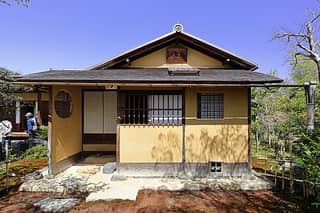
Why Joan at Urakuen is famous
Joan is one of Japan’s three National Treasure tea houses, built about 1618 by Oda Uraku and moved to Inuyama’s Urakuen garden in 1972.
Joan (如庵, also written Jo-an) is famous because it is one of only three tea houses in Japan designated a National Treasure, and the only one of those three that now stands outside the Kyoto area. The other two are Tai-an at Myōki-an, linked to Sen no Rikyū, and Mittan at Ryūkō-in in Daitoku-ji.
It was built around 1618 by Oda Uraku (Oda Nagamasu, 1547–1622), a younger brother of the warlord Oda Nobunaga, a disciple of Rikyū, and the founder of the Uraku school of tea. He made it for his retirement residence, Shōden-in, on the grounds of Kennin-ji in Kyoto. The room is a small grass-hut style space, about two and a half mats plus a daime. What sets it apart from pure Rikyū austerity is Uraku’s own detail: the tightly latticed “Uraku window,” calendar-paper wall covering (koyomi-bari), a distinctive central pillar, and an angled sleeve wall.
After Kyoto it passed through several owners, including the Mitsui family, and spent time in Ōiso. In 1972 Meitetsu moved the building beside Inuyama Castle and laid out Urakuen, “Uraku’s garden,” around it. It was named a National Treasure under the old system in 1936 and confirmed under the postwar law in 1951. The 2023 photograph at Gomonsaki is of that relocated building: a rare surviving early-seventeenth-century tea room, famous for the rank of its designation, the Nobunaga–Rikyū lineage of its builder, and a design that is recognizably Uraku’s rather than a copy of Rikyū.