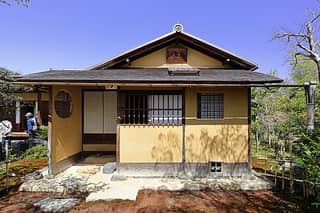
Why Jo-an at Urakuen is famous
Jo-an, the tea house in the 2023 Urakuen photo, is one of Japan's three National Treasure tea rooms, built about 1618 for Oda Uraku and moved to Inuyama in 1972.
The photograph titled Joan in Urakuen is of Jo-an (如庵), one of only three tea houses in Japan designated a National Treasure. It stands in Urakuen garden at Inuyama Gomonsaki, just east of Inuyama Castle in Aichi.
Oda Uraku (Nagamasu), younger brother of Oda Nobunaga and a disciple of Sen no Rikyu, had the room built around 1618 at Shoden-in, a subtemple of Kennin-ji in Kyoto. The garden takes his tea name. The room itself is often linked to his Christian baptismal name, Joan. It is a two-and-a-half-mat plus daime tea room under a shingle roof, with a crawl-in nijiriguchi, the bamboo lattice called the Uraku window, calendar-paper wainscot (koyomibari), a slanted wall beside the tokonoma, and a central pillar. Those details are his own taste, not a copy of Rikyu's Tai-an.
It was listed as an Important Cultural Property in 1936 and as a National Treasure in 1951. The other two National Treasure tea rooms are Tai-an at Myoki-an in Yamazaki and Mittan at Daitoku-ji Ryoko-in. After the Meiji era the building passed through Mitsui family houses in Tokyo and Oiso before Meitetsu moved it to Inuyama in 1972. Architect Horiguchi Sutemi laid out the garden to recall the Kyoto setting. The old Shoden-in shoin, an Important Cultural Property, stands with it. Most visitors see the exterior; the interior opens only on limited reserved days. Koan, inside the garden, serves a bowl of tea.
That is why the place is famous: a surviving early-Edo tea room by Nobunaga's brother, one of three National Treasure chashitsu, relocated so it can still be visited beside Inuyama Castle.