Saint Anne of Faras: What does the lip-touching afterimage say
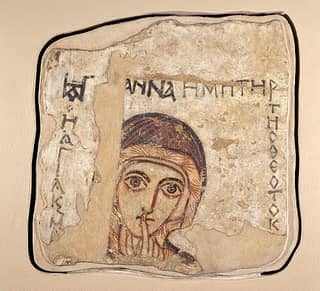
Ruined wall of Faras Cathedral: 8th–9th century Nubian Saint Anne, called in Greek the Mother of the Mother of God, index finger to her lips, now in the National Museum in Warsaw.
This painting is not the usual Holy Family portrait found in European churches, but a fragment from the north nave wall of the Faras Cathedral in the Nubian kingdom of Makuria. Warsaw National Museum no. 234058, approximately 69 × 68.5 cm, generally dated to the 8th century to the first half of the 9th century. The technique is dry tempera (al secco) on plaster, not fresco.
Only the head, shoulders, and upper right hand survive. The Greek inscription reads "Anna, mother of the Mother of God," so the figure is Saint Anne, mother of the Virgin Mary, not an anonymous woman. She has no halo, which is rare in icons. Her right index finger is pressed to her lips; among known depictions of Saint Anne, only this one makes this gesture. There are several interpretations: a call for silence; a reference to the three "silences of God"—Mary's conception, her virginity, and Christ's birth; or a monastic practice of guarding the mouth with a finger during prayer to keep evil thoughts from entering. None can be proven from the image alone.
It was painted on the first layer of plaster in the north nave, about three meters above the floor, and was later covered by a second layer bearing Queen Martha. It was uncovered in situ by a Polish archaeological team in the 1960s during the UNESCO Nubia campaign, entered the Warsaw collection in 1964, is now displayed in Room 6 of the Faras Gallery, and was once used as the museum's logo. On the same wall there was later a Saint Anne holding the infant Mary; that fragment is in the Sudan National Museum in Khartoum. The north nave also contains images of a female donor, a queen, martyrs, and mothers; scholars suggest this area was devoted to women's private prayer, with people petitioning Saint Anne for fertility and the safety of mother and child, since in the apocrypha she was barren before bearing a daughter.
So what this image shows is: how Nubian Christians turned the Byzantine tradition's Saint Anne into a silent, halo-less protector of whom only half a face survives—not just a random fragment of wall.
