Why Jo-an in Urakuen is famous
Jo-an is a 1618 tea house built for Oda Urakusai, a National Treasure since 1951, and one of Japan's three finest chashitsu, now in Inuyama's Urakuen.
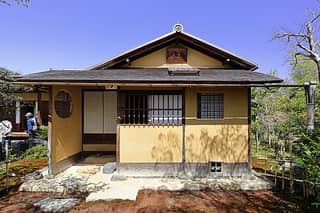
The photograph shows Jo-an (如庵), a seventeenth-century chashitsu, or tea house, standing in the Urakuen garden at Gomonsaki in Inuyama, Aichi. It is famous because Japan designated it a National Treasure in 1951, and because tea people have long counted it among the three finest tea houses in the country, with Tai-an in Kyoto and the tea room of the Shokin-tei at Katsura.
Oda Urakusai, younger brother of the warlord Oda Nobunaga and a student of Sen no Rikyu, is said to have built it around 1618 at Kennin-ji in Kyoto. The name Jo-an is written with the same characters as the second half of Urakusai's Buddhist name, so the building is remembered as his own room rather than a palace hall. After several moves it was reassembled in Urakuen in 1972, on land tied to the old Owari domain the Oda clan had ruled since the fifteenth century. The 2023 photo therefore shows a Kyoto tea room that ended up in the clan's home city.
What makes the room itself famous is how small and severe it is. Guests approach through the roji, the dewy-path garden, then enter by a nijiriguchi, the low crawl-in door that forces everyone to bow, rank included. Inside, the tea room is only two and a half tatami plus a three-quarter daime mat and a tokonoma alcove. A three-mat mizuya is for preparation, and a one-and-a-half-mat corridor room links the parts. The roof is wooden shake shingles, and a bamboo lattice window lets in a thin, broken light. That plan is the wabi ideal Rikyu taught: a tiny wooden box where the host and guest meet without display.
So the fame is not the garden view or the 2023 snapshot. It is a surviving National Treasure tea house built for Nobunaga's brother, moved intact to Inuyama, and still used as a standard of how a tea room should feel.
