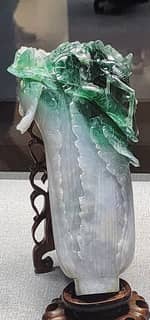
A head of cabbage—what makes it a national treasure?—the Jadeite Cabbage at the National Palace Museum, Taipei
Qing dynasty jadeite cabbage, 18.7 cm long, 9.1 cm wide, 5.07 cm thick, collection of the National Palace Museum, Taipei, accession number 故玉002103. The jade craftsman cut along the jadeite's natural white and green colors: the deep green became the vegetable leaves, and the white with cracks and impurities became the stalk, while at the tip of the leaf sit a katydid (commonly called guoguo) and a locust. It was originally a palace display bonsai standing in an enamel basin, and at the end of the Qing dynasty it was kept in the Yonghe Palace where Consort Jin lived; under Taiwan's Cultural Heritage Preservation Act classification, it is an "important antiquity."
Let's start with a contrast: it is one of the most beloved and longest-queued-for pieces at the National Palace Museum in Taipei, yet strictly speaking it is not legally a "national treasure." Taiwan's antiquities classification has three tiers—"national treasure / important antiquity / general antiquity"—and the Jadeite Cabbage was designated an "important antiquity" in 2014. So why does a cabbage make everyone treat it as a national treasure?
First, look at the object itself: Qing dynasty, 18.7 cm long, 9.1 cm wide, 5.07 cm thick, accession number Gu Yu 002103, made of jadeite (fei cui). The raw stone was far from perfect—half grayish-white, half emerald green, with cracks and impurities in the white portion. The jade carver did not grind away the flaws; instead he cut along the colors: the deep, dense green carved into layer upon layer of wrapping leaves, the flawed white turned into fresh, moist-looking stalks, and the cracks made to look just like the veins on the stalks. At the top of the leaves he carved a katydid (commonly called a guoguo) and a locust, and the whole thing instantly came alive with a pastoral vitality. Next time you visit, try counting: how many insects can you find?
Its story is half clear and half later legend. The clear part: it was originally a palace display bonsai, standing in an enamel basin as if "planted," and in the late Qing it was kept in the Palace of Eternal Harmony (Yonghe Gong) in the Forbidden City. Yonghe Gong was the residence of Consort Jin of the Guangxu Emperor, and so some speculate it was her dowry—that is only speculation. As for the familiar meaning of "many sons and grandsons, pure and spotless," according to research in the National Palace Museum Monthly of Chinese Art, it was added around 1986 by then-director Qin Xiaoyi, drawing on the "Katydid" poem in the Book of Songs; its original owner and purpose can no longer be verified.
So what gives it its status? Not because it is the most valuable, nor the oldest—compared with Shang and Zhou bronzes or Song dynasty painting and calligraphy, it is young as a child. What it has going for it is this: a flawed stone was made into the most homely, cheapest of vegetables, one anyone recognizes at a glance. Among court artifacts that feel so distant, this touch of cabbage gives ordinary people an instant connection to the palace. Ingenuity turned defects into highlights—that is probably what moves people most about it.
(Image: photographed by Wombatjpw, CC BY-SA 4.0, Wikimedia Commons. This is the second piece in the "Illustrated National Treasures of the National Palace Museum, Taipei" series; the first was the Mao Gong Ding.)